IONM in Scoliosis Surgery: The Gold Standard of Care
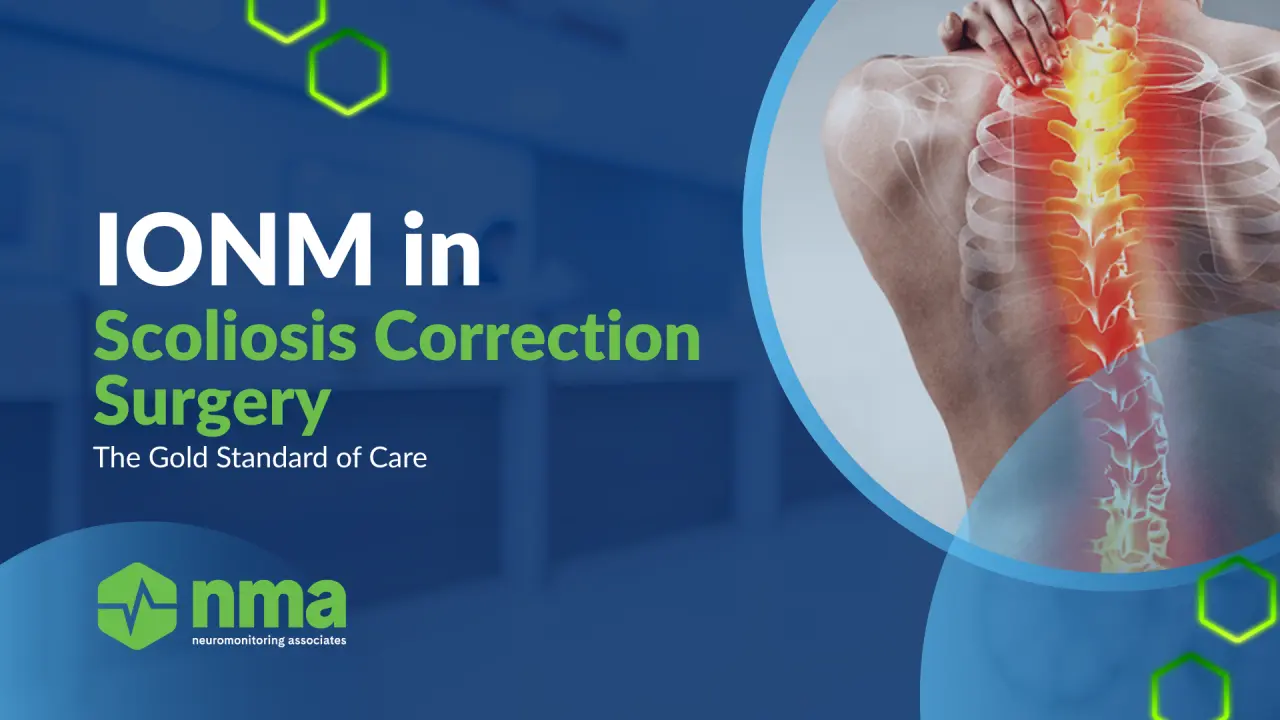
Scoliosis corrective surgery represents one of the most technically demanding procedures in spine care. While modern instrumentation techniques—such as pedicle screw fixation—have significantly improved deformity correction, they also introduce measurable neurological risk. Even transient compromise of the spinal cord, nerve roots, or vascular supply can result in permanent postoperative deficits.
This is where continuous intraoperative neurophysiological monitoring (IONM) plays a decisive role.
A 2022 peer‑reviewed case report published in Cureus by Jahangiri et al. provides a clear, real‑world demonstration of how multimodality IONM directly alters intraoperative decision‑making and prevents neurological injury during severe scoliosis correction surgery.¹ For neurosurgeons, orthopedic spine surgeons, anesthesiologists, and hospital administrators alike, the implications are significant—not only clinically, but operationally and medicolegally.
Understanding the Neurological Risk in Scoliosis Correction
Scoliosis is defined as a spinal curvature greater than 10 degrees based on Cobb’s angle, with adolescent idiopathic scoliosis accounting for approximately 75–80% of cases.¹ While many patients remain asymptomatic, severe deformities—typically those exceeding 40 degrees—often require operative correction to prevent progression, cardiopulmonary compromise, and long‑term disability.
Pedicle screw instrumentation has become a standard technique due to its mechanical stability and ability to achieve significant curve correction. However, the anatomical proximity of pedicle screws to the spinal cord, nerve roots, and segmental vessels creates unavoidable risk. Reported misplacement rates reach up to 15.7%, with ischemic injury, traction injury, and direct neural trauma representing the most serious complications.¹
Crucially, many of these injuries are physiological—not purely anatomical. Visual inspection and imaging alone cannot reliably detect early spinal cord ischemia or stretch injury. Neurological compromise may already be underway before gross structural damage occurs.
Why Multimodal IONM Is the Gold Standard
IONM is designed to continuously assess the functional integrity of the nervous system—not just its structure—throughout surgery. In the referenced case, a multimodal IONM protocol was employed, including:
- Somatosensory Evoked Potentials (SSEPs)
- Transcranial Electrical Motor Evoked Potentials (TCeMEPs)
- Spontaneous and Triggered Electromyography (s‑EMG, t‑EMG)
- Train‑of‑Four (TOF) neuromuscular monitoring¹
Each modality contributes unique, complementary information. SSEPs monitor dorsal column sensory pathways and perfusion, while TCeMEPs directly assess corticospinal motor tract integrity—often detecting ischemia earlier than SSEPs alone. EMG provides nerve‑root–specific feedback, particularly during pedicle screw placement, and TOF ensures anesthetic conditions remain compatible with reliable neuromonitoring.
No single modality is sufficient on its own. The strength of IONM lies in integration, interpretation, and immediate communication with the surgical team.
Case Insight: Real‑Time Intervention Prevents Neurological Injury
The case details a 10‑year‑old patient with an extreme Cobb’s angle of 120 degrees undergoing scoliosis correction surgery. Baseline neuromonitoring signals were stable and reproducible prior to instrumentation. Shortly after placement of a left L2 pedicle screw, a sudden amplitude reduction in left lower‑extremity TCeMEPs was detected and immediately reported.¹
Despite prompt screw removal, signals failed to recover—prompting further assessment. The neuromonitoring team identified traction‑related spinal cord compromise. When 25 pounds of traction weight were removed and mean arterial pressure (MAP) was increased, motor signals returned to baseline within minutes.
Later in the procedure, IONM detected:
- Upper‑extremity SSEP changes caused by positioning
- Bilateral SSEP and TCeMEP loss associated with hypotension
- Full signal recovery following physiologic correction¹
At no point did the patient sustain postoperative neurological deficits—immediately post‑op or at three‑, six‑, and twelve‑month follow‑up.¹ Without continuous multimodality IONM, these intraoperative events could have progressed unnoticed until irreversible injury occurred.
Evidence Beyond a Single Case
The findings align with broader peer‑reviewed literature cited by the authors:
- SSEP monitoring demonstrates 95% sensitivity and 99.8% specificity during scoliosis correction
- Patients with postoperative neurological deficits were 250 times more likely to experience intraoperative TCeMEP changes
- TCeMEPs show superior specificity (0.96) for detecting motor tract injury compared with SSEPs alone¹
These data reinforce a critical conclusion: motor and sensory pathways must be monitored simultaneously to effectively mitigate neurological risk.
Establishing IONM as a Standard of Care
Modern scoliosis correction demands more than technical excellence—it requires real‑time physiological insight. Multimodal IONM allows surgical teams to distinguish between:
- Mechanical versus ischemic compromise
- Reversible versus evolving injury
- Positioning artefacts versus true spinal cord insult
From a health‑system perspective, this translates into improved patient outcomes, reduced complication rates, increased surgeon confidence, and lower long‑term medicolegal exposure.
As emphasized by Jahangiri et al., multimodality IONM should be regarded not as an optional adjunct, but as a standard of care in complex scoliosis correction surgery.¹
Key Takeaways
- Scoliosis corrective surgery carries inherent neurological risk, especially with pedicle screw instrumentation and traction.
- Multimodal IONM provides continuous, real‑time assessment of spinal cord and nerve root function beyond what imaging can reveal.
- TCeMEPs are highly sensitive to early ischemic and traction‑related injury, often preceding irreversible damage.
- Timely intraoperative interventions guided by IONM can reverse neurological compromise and prevent lasting deficits.
- Clinical evidence supports multimodality IONM as a standard of care, not a luxury, in complex deformity surgery.
At Neuromonitoring Associates, our mission is aligned with this evidence: protecting neurological function through expert monitoring, immediate interpretation, and seamless collaboration with surgical teams—because when every signal matters, experience makes the difference.
References
- Jahangiri FR, Jahangiri RH, Asad H, Farooq L, Khattak WH. Scoliosis Corrective Surgery With Continuous Intraoperative Neurophysiological Monitoring (IONM). Cureus. 2022 Oct 5;14(10):e29958. doi: 10.7759/cureus.29958. PMID: 36381772; PMCID: PMC9635845.